Thursday April 4, 2024
It’s early morning. The heat of the day has not driven me inside, but it will soon. I can see the hills of the Western Valley from my balcony. The hot air balloons are up and drifting across my view between two rows of palm trees. The garden below is being tended by the small phalanx of gardeners. No doubt the flamingoes have been released from their pen to wander the grounds. Such odd ungainly creatures.
There’s a haze. It seems to be every morning the same. A gray bluish color, I’m not sure if it’s humidity from the Nile or dew or sand. Whatever it is it lends a mystical timeless quality to the view of the deep ravines of the hills beyond.
Timeless Egypt. I think about the long history of this place. Three periods of pharaonic rule, three periods of tumult. Any one of those periods of tumult are equal to the whole history of the United States. After those times Alexander entered Egypt, became a pharaoh and the Greeks came to rule. The country slipped into decline. The last real hoorah was Cleopatra, then the Romans, Christianity, and finally the Arabs and Allah. The end of ancient Egypt. The knowledge of the hieroglyphs was lost, as was the history. Slowly, it’s been regained. We still struggle to understand what they thought; what they knew.
A few weeks before I left I got a text from Martin. He wrote, “Get this book.” I have learned it is good to follow his advice. I got the book: Dendera, Temple of Time, The Celestial Wisdom of Ancient Egypt by José María Barrera. Barrera is an engineer. He was drawn back to the temple to photograph the Outer Hypostyle Hall. He took thousands of beautiful photographs and stitched them together to form panels to describe the ceiling. He took the time to describe the astronomical progression of the stars and their meaning in terms of the Zodiac and in terms of the motion of the Earth and its 40,000 year wobble.
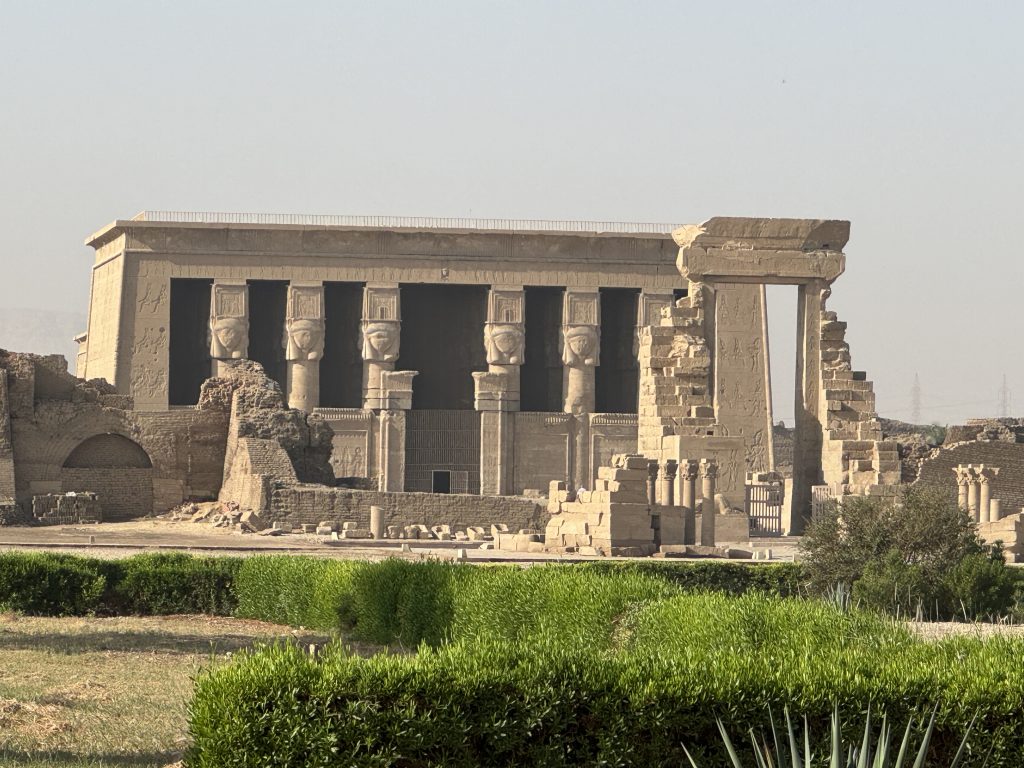
I had to go to Dendera on this trip. I did so after the group left. My friend, Ahmed Ayasha who calls himself Laird Hamilton because of his resemblance to the Formula One driver, and I left at 6am to beat the heat. We arrived at eight. I spent time wandering and photographing the ceiling. I did a 360 video of the hall. The temple is dedicated to Hathor. She is often depicted as a cow and is associated with fertility. Each column is adorned atop with her bovine features.
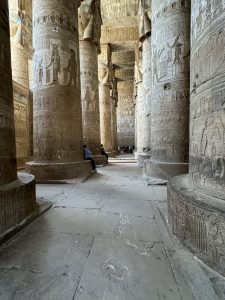
The Pronaos Hall
This forecourt, called a pronaos, is a hypostyle hall, which means it stands before the naos (the holiest part of any Egyptian temple housing in a small stone box the temple’s god) and hypostyle refers to the fact that it is a stone covered pillared enclosure. This book only dealt with the pronaos, the forecourt. The rest of the temple complex is left for others to describe.
There are 24 columns in the pronaos, split down the middle by a center hall. The interior has nine columns on each side with six columns built into the front wall. The temple sits on a north south axis facing the Nile, which is odd, because most temples facing the Nile would be oriented east west, however, due to the fact that the river takes a huge jog at this point to face the temple toward the river required this ninety degree shift in orientation. As the Nile is the life blood of the country, now and back then, it is always a focus of whatever one is doing.
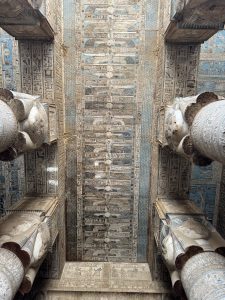
The forecourt is divided in half by a center hall. The ceiling describes day and night. There are three long panels running north and south on each side. On the east side working out from the center the panels describe day, light, and life. The west panels describe night, darkness, and death. This is in keeping with the Egyptian belief system that the sun rising in the east represents life and rebirth. The west where the sunsets represents the setting sun darkness and death.
The west bank is where the pharaohs are buried because it is the place of death and the entry into the afterlife. The Valley of the Kings is a hot dry place. Most tourists go to the eastern valley because that is where most of the tombs are located. However, if you go to another branch, the western valley, it is a place of immense quiet and solitude. Standing in the western valley you become aware of the quiet. It is understandable why the pharaohs would think of The Valley of the Kings as a place of eternity. It is quiet and unchanging. Only the sun’s passage and the movement of shadows in the dry still air breaks the quiet, and the shadows are silent.
The central hall of the pronaos represents the present. The first east panel (the day side) represents the hours of the day, the west (the night side) the phases of the moon.
Unlike our idea of an hour, which is divided into sixty minutes, the ancient Egyptian hour was based upon the movement of the sun, and as the day lengthened so did the hour. The day and the night were divided into twelve hours. It seems that the day hours began at dawn (not sunrise) and ended at dusk. About an hour before sunrise and sunset. Night time was measured by phases of the moon and or by water clocks.
Each hour on the day side was represented by a boat with the sun (Ra or Re) in the middle of the boat being worshipped by various gods in different forms. The bow of the boat had a creature sitting. Each hour had a specific creature. The early morning hours had a youth sucking his thumb to signify the new young day. As the day progressed other iconic forms took the bow. The helm was steered by various gods as well.
The second panels moving outward represented the decans. Decans are the grouping of 36 stars. Each decan represents ten degrees longitude. The decan is used to measure the passage of time during the night and also the passage of time during the year, as a decan will advance ten days. The Egyptian calendar was made up of three seasons of four months each. Each month being thirty days. Plus a five day period. The decans advanced throughout the year marking the solar calendar.
The third panels, the outlying ones, measure the procession of the Zodiac throughout the year. Because the Zodiac is slightly delayed each year these panels also measure The Great Year (of 26,000 years). For astrological purposes it was important to know what Zodiac sign was behind the sun at the vernal equinox (ie the time in which the sun passes the equator and day and night are equal. March 20th.) Each constellation having a period of some 2,166 years in that position, known as an astrological age. But the Zodiac falls behind each year a little bit, known as retrograde motion. In ancient times Taurus was the constellation behind the sun at the vernal equinox, then Aries. We are now entering the Age of Aquarius. (thank you Hair.)
This temple was built on the remains of an earlier temple. It was constructed during the Ptolemaic period with Cleopatra being one of the main proponents and finished under the Roman Emperor Claudius.
So there is a mixture of ancient Egyptian symbology along with Roman/Greek Zodiac symbology.
What makes this temple so intriguing is that it is in wonderful condition. There was some defacement by Christian fanatics, but by and large it is in excellent shape. The colors are all original.
It is stunning.
And that is just the forecourt. There is the rest of the temple, but that is a story for another time.
Leave a Reply